|
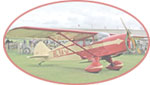
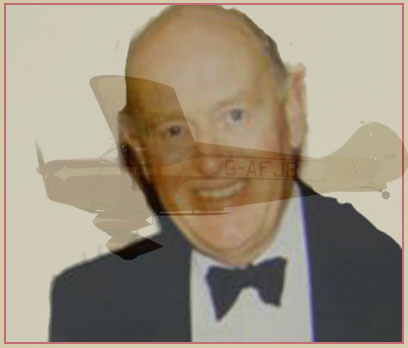
I bought G-AFJB in February 1955 from Lettice Curtis who had previously raced it, hence it had a very coarse pitched propeller. Housed in the back of one of Fairey's hangers at white Waltham, I had to await Robin Hood's pleasure, as Works manager, before it could be extracted. As we know, few Wickos were built, an early one with a Ford V8 liquid cooled car engine, another with fabric wings and a Cirrus Minor engine, which I bought from a private owner in the west country, only to find the oil filter full of white metal! The succesful version, which I bought, had the Gipsy Major engine, with the rubber mounts upside down! All can remember about flying the Wicko, was that one had to peer under the main spar, which ran across the cockpit. The flap lever sockets were rather worn and the flaps would sometimes come off without being invited. The rudder trim consisted of a spring and bottle screw lying across the cockpit floor and attached to one rudder pedal. I think the cruising speed was 90kts, an improvement of over 30kts on my previous Aeronca. Its worst feature was the loss of pitch control during the flare, due I presume, to blanketing of the rather small tailplane. One seemed nicely set up for a three pointer, when all of a sudden the nose rose and threatened to stall from an uncomfortable height. Pitch control was lost until power was applied for another try further down the "runway", or an overshoot. Eventually I gave up trying to three point it and did a wheeler everytime. When I had the aircraft, the late Doug Bianchi deleted the root fairings on the tailplane, because they were damaged beyond repair, through constant removal. It will be interesting to see if the replacement of these fairings, when'JB is rebuilt, makes any difference. The aircraft was aerobatic if not more than 8 gallons of fuel was carried for C of G considerations. In my case this balance point was not helped by having a Magister tailwheel fitted in place of the tail skid, thought it did improve ground handling, which was not brialliant in view of the forward restricted visibility. On one occasion I collided with a boundary marker at Jersey, much to the annoyance of Griffiths, the airport manager, though doing little damage to 'JB. On the engineering side, I found the taxi ride very rough and on dismantling the undercarriage, which consisted of thick rubber discs in compression, I found the rubber had chaffed against the tubes and formed a sticky mess, which effectively caused the legs to seize. The cure was to use aluminium spacers between the rubber discs. I also found the oil temperature rather on the high side as the oil tank was heated by an adjacent exhaust stub. I cured this by making a cowling round the tank and adding an air scoop outside the cowling, so that outside air passed over the oil tank and instead of exhaust heated air. Working for Sperry at the time, air driven gyro horizons were freely available, so I got hold of some plywood and remade the small panel with a horizon and added a larger venturi in the hot part of the airstream under the fuselage, to prevent icing. There was already a turn and slip, but no room for a directional gyro. However the big P type magnetic compass served well. The fuel guage was a combined automotive instrument and was u/s. I bought a surplus fuel gauge which worked on the principle of measuring the weight of fuel by a transmitting capsul, screwed into the tank drain plug. So the more "g" you pulled, the more fuel you thought you had!. One curious outcome of remaking the triangular panel with additional instruments, was no room for the makers name plate, which is this day nailed to my workshop wall, bearing the serial No: WO1. When Joe bought the remains of 'JB, the serial plate was there, bearing the serial number 7! 'JB with the Gipsy engine was a lively aircraft and one day I took her up to 10,000ft, whereupon the windscreen cracked in the cold and I had to make a new one, bending a sheet of perspex round a one bar electric radiator. I sold 'JB in August '56 having flown almost exactly 100 hours, mostly by self and including several trips to Paris and Le Touquet, for the simple reason that the structure was not bonded, nor was there any electrics, so that radio was a non starter in those days. At this point I went on to Proctors.
|