|
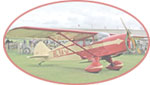
I first flew the Wicko on the 6th February 1955. At the time I had achieved some 200 hours total and was half way through the RAF flying training of the day. The Provost Vampire scheme and I see that by that date I had soloed in a Vampire T11. I considered the T11 a bit of a slow poke. What would you expect when you graft a basic side by side Mosquito cockpit onto a Vampire airframe and attempt to push it through the air with 3150 lbs. of poke? The 5 and 9 was nicer being lighter and better controlled. It was not called the "Kiddie car" for nothing. The Provost on the other hand had nicely harmonised controls and plenty of power if the full 8lbs boost was used. The Wicko had a distinct advantage over most of the club light aircraft available at the time. Differential wheel brakes and camber changing flaps were fitted and both were effective. Its controls were good and crisp with really deadbeat stability. With a fair rate of roll it encouraged aerobatics for which it was cleared one up and with limited fuel. I only found out recently that during testing it had a reluctance to recover from a spin when the tank was filled and the weight of a passenger was carried. Indeed in Geoff Wikner's book "The Flight of the Halifax" he describes that on a test flight to observe spinning characteristics and only when the aircraft had been fitted with an anti spin 'chute and when he was wearing parachute a series of spins was carried out. At the end of the programme the aircraft refused to recover. When things were getting too exciting and a bale out was on the cards he reached forward to deploy the spin chute as a second last resort. The aircraft suddenly recovered. His diagnoses, when safely on the ground and in the privacy of his office and no doubt after a stiff one, he considered that by reaching forward and shifting his whole body weight to reach the release handle the C of G was sufficiently moved to allow a normal recovery. Hence the cockpit placard that clearly stated that "one only and not more than 8 gallons of fuel could be carried if aerobatics were contemplated." I note that on September 13th 1955 (I wonder if that was a Friday 13th!) I carried out 50 mins of "Aeros, spins etc." I clearly remember spinning the Wicko on that day in both directions and it both entered and recovered cleanly. Loops were easy but the vis from the rear of the cockpit roof was poor. I do not remember the roll performance though it is likely that my rolls were of the barrel type but the Wicko had good ailerons. Stall turns in both directions were a synch helped by that large rudder, placed were it should be found at the extreme end of the fuselage. (As an aside I do not think I would have been so keen to throw the aircraft about so much as we found, during the restoration, that one of the metal fittings that coupled a lift strut to the fuselage was 60% cracked!) However, what did catch the unwary was the lack of elevator response at high AoA. On the 5th August 1956, when James Gilbert was onboard we flew to Le Touquet from Croydon. On arrival, in glorious sunshine and light winds, we wafted down the runway with self on the handlebars, with the nose pointing at the heavens and no worthwhile airspeed visible on the dial and full flap selected. James was in fits of laughter and that did not help one bit either. Eventually the aircraft settled but I think at that stage we had removed the flap. After that one paid full attention to the round out and did semi wheelers as a compromise. There was never a stopping problem as the wheel brakes were good. However the tailplane fairings had been removed as they had deteriorated beyond economic repair and one wonders and waits to fly the new tailplane and fairings and the hoped for improved elevator performance at low speed. Interestingly Wikner increased the elevator chord in subsequent Wickos after JB. As non are now flying we will never know if it made any difference. Perhaps the worst feature of this exciting light aircraft of the period, with it's high cruise speed and some 5 hours endurance making it a capable touring machine, was the lack of forward view from the seats over the nose. Clearly efforts to improve the situation at the design stage as the instrument panel and fairing is cut away sharply from the apex thus allowing the maximum amount of windshield glazing. Nevertheless the view from across the two seats is restricted and care is needed in taxiing. The main spar also runs across the roof of the cockpit discouraging the use of cushions to raise the eye level, that is unless you want to crack the skull. Obviously "bone domes" were not about in the late thirties. The root ribs are canted sharply out board this allowing the cockpit roof glazing between the spars to be maximised. A good view can be obtained in steep turns though not so good to the rear of the aircraft. Ground handling was no problem except to watch the limited forward view as described above. Turns on the ground could be easily executed using the differential brakes, which were capable of holding the aircraft at full power. Now that the tail wheel which replaces the skid and in the original position will be biased to the rudder and brakeless turns will now be possible. We took the Wicko to Paris, Toussus Le Noble, and to Le Touquet on a number of occasions and all without any radio assistance of any kind. The desire to have elecrics and radio eventually led to the sale of the Wicko and my brother purchased Proctor 11, G - AIEH. A memorable flight, shortly before the departure of the Wicko, when I flew the Wicko in close formation with the Proctor from White Waltham to Denham and loose formation the following weekend to Le Touquet for duty free fuel and buckets, literately, of wine to bring to the UK. And so the Wicko departed in mid August 1956. I had flown 21 hrs 05 mins in the machine and was sad to see it go in favour of the sophisticated four seat Proctor with yet more speed and range and that long felt want ..............WIRELESS! I don't know when I got the crazy idea that a new build or restoration of an aircraft came into mind. It could have been, shortly before retiring from airline flying on an eastbound crossing of the Atlantic in a 747, when a young American lady flight engineer visited the cockpit and announced that she was to present a paper on the life of a retired airline pilot when they cease to fly.
She had degrees up to her pretty
armpits and was busy baffling the crew with science. I asked
her, in a few words, if she had any real advice for retirees.
|